The latest edition of Critical Stages, the web journal from the International Assoication of Theatre Critics / Association internationale des critiques de théâtre (IATC-AICT), is now online for your perusal. New editor-in-chief Yun-Cheol Kim sent along the following announcement letter, which has been edited for length:
The fourth issue of Critical Stages is finally posted. We am very proud that each issue of the journal has been visited by more than 50,000 readers. Please visit the IATC web journal at http://www.criticalstages.org/, and invite your colleagues, students, and your entire theatre community to visit and make use of it.
Starting with this issue, three major changes have been implemented. New editions of Critical Stages will be posted every June and December. This scheduling adjustment allows writers to address more theatre-oriented events, and provides more time for pieces to be written. A second change, and a rather painful one, was imposed upon us: Maria Helena Serôdio stepped down from her position as editor-in-chief, after having orchestrated the first three issues. Her expertise, competence, and sacrifices have been crucial to the birth of this journal. Critical Stages might well not have been possible without her leadership. As a result of Serôdio’s return to the editorial board, I have taken on the editorship myself; however, I think of myself only as an interim editor-in-chief, serving until we find a replacement.
In my role as the new editor, I have brought about a third set of changes. I have created a section called Special Topics that will accommodate articles or statements on current issues surrounding aesthetic or thematic approaches to the theatre; regional or global theatre arts policies; or other interesting phenomena of social significance to the contemporary theatre. I have also designated Section Editors, who will take the initiative to keep their respective sections dynamic. These changes have worked well, and that can be seen in this issue.
The special topic for this issue is “Censorship in Disguise.” Recently, there have been reports of unfortunate and anachronistic occurrences of political intervention into cultural policies, particularly in Central and Eastern Europe. As President of IATC, I publicized my letters of protest on the cases of Hungary, Belarus, and Serbia, to protect the rights of our colleagues and their freedom of speech in theatre criticism; two of these letters are posted on the IATC website: www.aict-iatc.org. In this time of “Jasmine Revolutions,” censorship of any kind is pure nonsense. Andrea Tompa and Ivan Medenica let us know, through their reviews of Hungarian and Serbian performances respectively, how theatre artists have responded to these actions. Randy Gener has been keeping a keen watch on the agonies of the Belarus Free Theatre and gives us vivid reportage on the censorship and persecution of this courageous political theatre group.
Bringing further breadth to this topic elsewhere in the issue, Jean-Pierre Han’s review of the Iranian theatre and Alvina Ruprecht’s essay on the Cuban theatre are also written with reference to the notion of “censorship in disguise.” Taken all together, we have such a rich cluster of articles on the first special topic, both within and without the section itself, that they serve as a mandate for us to fight together against this evil practice, with vehemence and commitment.
The sections devoted to Interviews, Essays, Conference Papers, Performance Reviews, Book Reviews, and Critics on Criticism feature a broad and diverse collection of global perspectives on theatre and theatre criticism.
We are proud to present this fourth issue of the journal, which contains so much interesting work. Unfortunately, we live in a time when theatre criticism is being radically and rapidly reduced in stature. Let’s set aside, though, any pessimism, or even defeatism. Instead, we should raise our voices and speak up for the sake of theatre criticism and theatre art. Critical Stages proves, for the fourth time, that it serves this crucial cause very well.
Yun-Cheol Kim,
President, IATC
Editor in Chief, Critical Stages/Scènes critiques
International news, events and reports from the American Theatre Critics Association
Saturday, June 25, 2011
PUBLICATIONS: New Critical Stages Available
Sunday, February 27, 2011
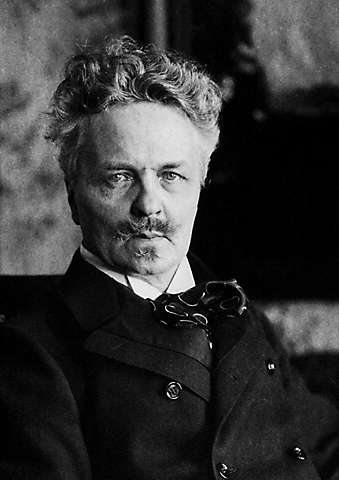
CALL: Strindberg’s Legacy (Sweden)
From DAVID GEDIN of the Strindberg Society
| August Strindberg (ca. 1900) |
August Strindberg died in 1912 at the age of 63. Since his death Swedish and international scholarship have made the perspectives on his time and his work considerably broader and deeper.
How do we look upon his works today: his plays, his poetry, his prose, his aesthetical essays on theatre, his social and political criticism, his texts on science and his own paintings? How do we understand the society in which he lived? Strindberg’s Sweden was a country characterized by rapid industrial development and thorough cultural changes. How do we understand Strindberg’s relationship to this new society?
Every literary current has had its own interests and its own view of Strindberg both as a private person and as a writer. In what way has the conception of Strindberg and the use of his ideas changed through the years? From a working class hero to an avantgarde icon, from a psychological enigma to a corpus of texts?
Thursday, February 10, 2011
CALL: Contributions to Critical Stages
Critical Stages Invites
Submissions for Consideration
Web Journal
Critical Stages announces its fourth issue with a call for critical articles, essays, interviews, and reviews that contribute to cutting-edge, international discourse on the theatre.
Critical Stages aims to document, celebrate, challenge and foster internationally the discipline and the art of theatre criticism, with theatre broadly defined; to employ theatre criticism as a springboard for opening communication between theatre practitioners, theoreticians and the general public; to create “critical space” for the theatre critic to develop and thrive; to increase the general readership for theatre criticism by providing international readers with a source for information and dynamic discussion of themes and trends in contemporary international theatre.
Each submission should be sent as an e-mail attachment, double-spaced in MS Word. Articles will typically range from 1,500 to 3,500 words. Please check with the Section Editor if the length is not specified below.
The journal publishes articles (not interviews or reviews) with an abstract, of no more that 200 words, in the alternate language. When possible, please submit English articles with an abstract in French; if this is not possible, the abstract should submitted in English and it will be translated. (For articles written in French, the reverse process should be undertaken.)
Submission Guidelines may be accessed here
Issue No. 4 Publication Schedule (2011)
JOURNAL SECTIONS
Issue No. 4 Publication Schedule (2011)
- Proposal Period: Now Open
- Full Draft Submission Deadline: April 30
- Writer Notification Following Readers' Reviews: The second week of May
- Writer Revisions and Formatting: The third week of May
- Publication: By mid-June 2011
JOURNAL SECTIONS
Please contact the individual Section Editor
to which your proposal relates
Performance Reviews welcomes critical appraisals of important, controversial, bizarre or simply good performances. The section hopes to report from as many different countries, cultures and languages as possible. The submissions must not exceed 1,300 words and must be accompanied by photographs of the performance. Section Editor: Matti Linnavuori (matti.linnavuori@welho.org)to which your proposal relates
Essays should offer a critical view on a particular topic. An essay might give an overview of an artist’s work—the journal recently printed two “in memoriam” pieces—but an essay might also celebrate a living artist. Alternatively, it could take a historical or analytical approach to a theatre venue, a theme—a recent theme was “painful memories,” for example—or a special questioning, such as previous essays regarding cultural identity and immigrant communities. Section Editor: Maria Helena Serodio (m.h.serodio@netcabo.pt)
Conference Papers. International theatre symposia and seminars play a vital role in the discussion of live drama throughout the world. The IATC is proud to play its part in this important area of critical work. The “Conference Papers” section will seek to offer an international platform for many of the most interesting and provocative papers presented in these public arenas. Section Editor: Mark Brown (mark.brown@strath.ac.uk)
Special Topics. This section invites three or four authors each to contribute an article or statement on current issues surrounding aesthetic or thematic approaches to theatre; regional or global theatre arts policies; or other interesting phenomena of social significance to the contemporary theatre. The editorial board may also consider unsolicited pieces. Each article will be more or less 15,000 characters (2,500-3,000 words).
The Special Topic for the coming issue will be “Censorship in Disguise.” See the Open Letter on the Oppression of International Artists of January 22, 2011, which is also posted on the AICT-IATC website. Section Editor: Yun-Cheol Kim (yunckim911@yahoo.com)
Interviews. Interviews are intended to compare and contrast the views of significant theatre artists from around the world. To this end, the section editor will provide interviewers with four previously formulated questions to pose. Interviewers are encouraged to ask additional questions to further illuminate or deepen the conversation. All articles are in a question-and-answer format, preceded by a critical introduction describing—not merely listing—the artist’s contributions or offering an explanation of why this person deserves recognition in an international journal. Submissions must include interviewee portrait and photographs of performances discussed in the interview. Section Editor: Randy Gener (rndygener@aol.com)
Book Reviews. Book Reviews will to review for each issue of the journal a selection of recently published books—generally not older than 24 months—that are considered to be of national and/or international significance for theatre workers generally and theatre critics and scholars in particular. Each issue should have a lead review of a major book that has been published in either English or French and should have an additional three to five reviews of books published across a range of languages (with particular emphasis on—though certainly not limited to—new books in German and Spanish). Reviews of important books in other languages will normally be published in either English or French. Section Editor: Don Rubin (drubin@yorku.ca)
Critics on Criticism. Critics on Criticism seeks:
- 1) In-depth profiles of, and interviews with, well-known senior critics: their careers and work, relationships to theatre audiences, conflicts and dilemmas, teaching experience, work in other theatre fields and art forms; and
- 2) Reflections, interviews or surveys on the teaching of criticism; the methodologies, theories and practices of criticism; comparison of courses given in different countries; theatre criticism’s relationship to other art disciplines; practical and theoretical dialogue between critics, scholars and others. Every submission should include basic information on the critic, including major publications, photograph, etc.
THE EDITORS
Yun-Cheol Kim (yunckim911@yahoo.com), Korea
Editor-in-Chief and IATC President
Lissa Tyler Renaud (English) (ltrenaud@gmail.com), U.S.A.
Michel Vaïs (French) (vais@ca.inter.net), Canada/Quebec
Co-Editors
Patrice Pavis (patricepavis@hotmail.com), France
Contributing Editor
Editorial Board Members
Mark Brown (mark.brown@strath.ac.uk), U.K.
Randy Gener (rndygener@aol.com), U.S.A.
Hervé Guay (rvguay@mlink.net), Canada/Quebec
Matti Linnavuori (matti.linnavuori@welho.org), Finland
Tomasz Milkowski (tomasz.milkowski@gmail.com), Poland
Manabu Noda (noda@kisc.meiji.ac.jp), Japan
Rodolfo Obregón (pasofranco@att.net.mx), Mexico
Ludmila Patlanjoglu (lpatlanjoglu@yahoo.com), Romania
Don Rubin (drubin@yorku.ca), Canada
Maria Helena Serôdio (m.h.serodio@netcabo.pt), Portugal
Maria Shevtsova (m.shevtsova@gold.ac.uk), U.K.
Halima Tahan (revista@teatroalsur.com.ar), Argentina
Andrea Tompa (tompa.andrea@gmail.com), Hungary
Thursday, January 27, 2011
BOOK: Margaret Croyden’s Journey
| The Years In Between |
Our longtime colleague Margaret Croyden—internationalist extraordinaire—has a new book in print. The Years In Between: A Reporter’s Journey World War II—The Cold War recounts Croyden’s memories and experiences as an actor “embedded” with American occupation troops in France and Germany just after World War II, who later went on to become the renowned critic and journalist we all know now. Her other books include Lunatics, Lovers and Poets: The Contemporary Experimental Theater and Conversations with Peter Brook: 1970-2000.
According to the publisher, The Years In Between is drawn “from diaries, tapes, and memories,” as Croyden “recounts her youthful adventures and struggles and a later transformation, this time ideological, wrought by visits to Berlin, Moscow, Leningrad, Beirut, and Jerusalem to report the theater scene and interview cultural and political leaders. Her vivid descriptions reveal a sharp mind, a critical eye, a humanistic sensibility, and a fearless dedication to the truth.”
Wednesday, January 26, 2011
WEB: New UK Resource
![]() |
| A Circle dinner at the Savoy in the late 1940s. |
The site is valuable for its current perspectives on criticism as well as fascinating bits of history of the UK association, which are posted under a “history” link.
Cargin includes a telling quote that has currency today:
“Criticism is passing, as many of us know, through a difficult phase. Its field is becoming more and more restricted. There are fewer papers than there were before the war and less space even in these.”
The words were written by S.L. Littlewood in 1923 first edition of The Critics’ Circular. Littlewood was at the time president of the group.
In addition to the historical information, there is a wealth of information on a variety of topics such as awards, events, and the ongoing challenges we face in arts criticism.
Saturday, January 22, 2011
OPEN LETTER: Oppression of International Artists
From Association internationale des critiques de théâtre / International Association of Theatre Critics (AICT-IATC)
In the wake of governmental repression of theater artists in Hungary and, more recently, in Belarus, the International Association of Theatre Critics (AICT-IATC) adds its voice to the global chorus calling for greater freedom on the pages of publications and on the stages of oppressed theatre companies.
As a non-profit, Non-Govermental Organization recognized under Statute B of UNESCO, the purpose of the IATC is to promote international cooperation through international engagement and advocacy for building bridges among cultures. In the recent repression and imprisonment of theatre artists, Aleksandr G. Lukashenko gives credence to critics who have called Belarus “the last true remaining dictatorship in the heart of Europe.” According to the New York Times, the deeply contentious election of December 19, 2010, after which Lukashenko claimed to have received 79 percent of the vote, led to the leader's announcement that more than 600 “bandits and saboteurs,” including several of his opponents, had been arrested.
The leadership of the IATC is deeply disturbed by the rising international tide of oppression of the arts and literature, especially of theatres and theatre artists. We deplore the conviction and brief imprisonment of Belarus Free Theatre's company manager Artiom Zhelezniak on charges of "illegal assembly." We celebrate the departure from Belarus of company members Nikolai Khalezin, Natalia Kolyada and others, who have been recognized internationally and were honored with a "Special Mention" by the Europe Theatre Prize.
Members of the IATC are theatre critics, but we are also theatre advocates and we will resist all governmental attempts to censor or otherwise marginalize the important work of our global theatre artists. When some artists and writers are not free to think, work, and create in an unrestricted manner, we all suffer a loss of freedom and of human possibility.
We call on all who love freedom—artists, audience members, governments—to rally against these specific oppressions, to agitate for greater creative freedom, and to join our voices in support of those who cannot, or may not, speak for themselves. We encourage our members to shine a bright light on these events and to keep these matters in the forefront of our global artistic discourse.
If we join together in this struggle, we shall prevail.
Sincerely,
Yun-Cheol Kim, President (Korea)
Michel Vaïs, Secretary General (Canada)
AN OPEN LETTER ON THE OPPRESSION OF INTERNATIONAL ARTISTS
As a non-profit, Non-Govermental Organization recognized under Statute B of UNESCO, the purpose of the IATC is to promote international cooperation through international engagement and advocacy for building bridges among cultures. In the recent repression and imprisonment of theatre artists, Aleksandr G. Lukashenko gives credence to critics who have called Belarus “the last true remaining dictatorship in the heart of Europe.” According to the New York Times, the deeply contentious election of December 19, 2010, after which Lukashenko claimed to have received 79 percent of the vote, led to the leader's announcement that more than 600 “bandits and saboteurs,” including several of his opponents, had been arrested.
The leadership of the IATC is deeply disturbed by the rising international tide of oppression of the arts and literature, especially of theatres and theatre artists. We deplore the conviction and brief imprisonment of Belarus Free Theatre's company manager Artiom Zhelezniak on charges of "illegal assembly." We celebrate the departure from Belarus of company members Nikolai Khalezin, Natalia Kolyada and others, who have been recognized internationally and were honored with a "Special Mention" by the Europe Theatre Prize.
Members of the IATC are theatre critics, but we are also theatre advocates and we will resist all governmental attempts to censor or otherwise marginalize the important work of our global theatre artists. When some artists and writers are not free to think, work, and create in an unrestricted manner, we all suffer a loss of freedom and of human possibility.
We call on all who love freedom—artists, audience members, governments—to rally against these specific oppressions, to agitate for greater creative freedom, and to join our voices in support of those who cannot, or may not, speak for themselves. We encourage our members to shine a bright light on these events and to keep these matters in the forefront of our global artistic discourse.
If we join together in this struggle, we shall prevail.
Sincerely,
Yun-Cheol Kim, President (Korea)
Michel Vaïs, Secretary General (Canada)
International Association of Theatre Critics (IATC)
Association internationale des critiques de théâtre (AICT)
Sunday, January 16, 2011
YOUNG CRITICS: Seminar Announced
From Michel Vaïs, Secretary General of AICT-IATC
The International Association of Theatre Critics (AICT-IATC) is pleased to announce a Young Critics’ Seminar to be held in conjunction with the 14th Europe Theatre Prize in St. Petersburg, Russia, April 12-17, 2011. The seminar will be comprised of three groups (working in the English, French and Russian languages), each of which will be open to a maximum of 10 participants.
The seminar groups will be led by three experienced theatre critics: Jean-Pierre Han (Francophone group), Mark Brown (Anglophone group) and Nikolai Pesochinsky (Russophone group). The annual Europe Theatre Prize has been awarded to many great theatre makers (Krystian Lupa, Patrice Chéreau, Peter Zadek, Lev Dodin), and showcases many world-class productions.
Applications are requested to be sent by e-mail to AICT-IATC Director of Seminars Jean-Pierre Han before February 28, 2011. Members of the American Theatre Critics Association considering application should contact Jeffrey Eric Jenkins by February 1, 2011. A list of successful applicants will be made available as soon as possible so participants may make arrangements for travel and visas.
| Palace Square, St. Petersburg |
Applications are invited from professional theatre critics between 18 and 35 years of age—there is flexibility in the upper age limit, members of the American Theatre Critics Association should contact International chair Jeffrey Eric Jenkins before submitting an application. The application form also requires a one-page CV, three examples of writing as a professional critic and a letter of recommendation from the critic’s national section of IATC.
| Hermitage Museum Complex, St. Petersburg |
Successful applicants will be responsible for the cost of travel to and from St. Petersburg, and the cost of any visa required for entry to Russia. However, the Europe Theatre Prize generously offers participants free hotel accommodation (you may be required to share a room with another participant of the same gender), meals and tickets for performances.
Applications are requested to be sent by e-mail to AICT-IATC Director of Seminars Jean-Pierre Han before February 28, 2011. Members of the American Theatre Critics Association considering application should contact Jeffrey Eric Jenkins by February 1, 2011. A list of successful applicants will be made available as soon as possible so participants may make arrangements for travel and visas.
Subscribe to:
Posts (Atom)